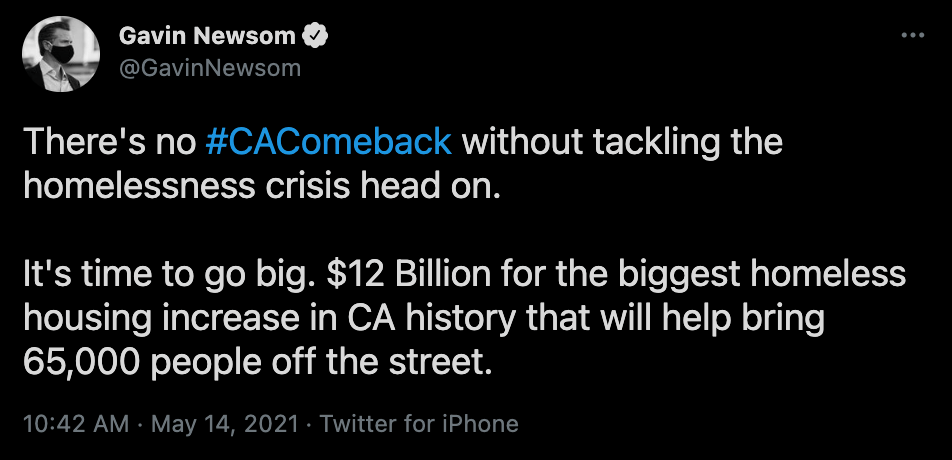
So my governor, Gavin Newsom, announced yesterday that he wants to put $12 Billion towards fixing the unhoused people/homelessness crisis in California. I have an idea of how to effectively use that money. It might be a little radical but I think it could work. Here it is:
He takes the money and pays for six or 12 month leases for them to live in all the vacant apartments around the state. The most recent number I found is there are 161K unhoused people in California. Let’s say the average rent for a vacant apartment is two grand (this is a broad generalization but I’m probably not too far off). Time for quick math:
161,000 * 24,000 = $3,864,000,000
That is a third of the budget to potentially house every unhoused person in the state. That is money going directly back to a number of different California residents/taxpayers/communities instead of developers to create middling tiny home villages like the one Garcetti just completed in North Hollywood (Los Angeles).
The unhoused people interviewed in the article are happy with the tiny-home village created in the San Fernando Valley. I’m glad the people who are using it are happy with the facility. What I am trying to get at is the village cost was around $5 million and each unit cost $7,500 with a total of 39 units (that are six square meters according to the article).
Time for some fast math: 39 * $7,500 = $292,500. How is the leftover $4,707,500 being spent? How much did Hope of the Valley receive to help provide additional services? To get 39 annual leases at $1500/month ($18,000/year) it would cost $702,000. But this is money going back to small businesses and tax payers, not developers who are friendly with local politicians. You would still have over $4 million left over to acquire more leases and give vital resources to community organizations that would be able to provide additional services to the unhoused residents.
A few more things about the nearly $4 billion number to house everyone in the state:
- Not every apartment will cost two grand, many will cost less
- Not everyone will want to accept this offer
- I think it’s a safe assumption a sizable number of people will choose to live together or are couples
- This will minimize all the administrator fees and extra pockets the $12 billion will go into while dealing with this problem
So the number to pay for 12 month leases for everyone is probably lower.
Now what about furniture? Partner with local furniture companies and all the mattress-in-a-box companies to get a deep discount on the basics in exchange for a tax write-off on donated product (plus they could get some great PR). This is especially good for local furniture companies because it puts this tax money directly back into communities where it originated.
Think of it like cash relief/direct payments. We don’t need tons of different agencies and municipalities to get involved to line their pockets. We need a simple website where landlords can register their vacant units. They have to list the cost of the other units in their building to show the price is comparable. Maybe start with the cheapest apartments and work your way up to the more/most expensive (this could also help entice landlords to lower their rent if they have multiple vacant units)?
This probably won’t work because it’s too straightforward (and NIMBY’s, more on them in the next paragraph). Everyone says we need to help the unhoused and do something about this continually growing problem in our state. Here’s a solution that leaves a lot of room for job training, food expenses, pre-paid public transit cards so people can get around for interviews and such.
NIMBY’s (Not In My Backyard) are the worst because they want the problem solved, and often have some level of humanity towards the unhoused people, but they’re the ones asking questions like “do you want an addict to move in next door to you?”. I want to respond to them like “Hey, elitist asshole, I probably already live next door to an addict or someone with mental health problems.” In all likelihood most of us already probably do. We don’t see it because we’re usually not paying that close attention to our neighbors. Or because we don’t stigmatize alcoholics and drug users the same way when they live in a building versus in a tent on a sidewalk or in a park.
I don’t think this one idea will be a universal solve for the problem but I do think it can be a smart approach for a lot of people who don’t have significant substance abuse or mental health issues. Stable housing helps improve peoples lives. If we offer humane and dignified solutions we can solve this problem. But we have to be willing to think differently about our approach. We cannot be narrow-minded and think only of ourselves in tackling this crisis. We are interconnected. And we are all humans.
Credit to Adam Grant for his genius book “Think Again” that allows me to take everything he writes about and put it to use to come up with ideas like this.
And another quick math for ya on a $1500/month rent for 12 months: 161,000 * 18,000 = $2,898,000,000
We don’t have to overcomplicate the problem to solve it. We can do this with minimal waste if we choose to (and decide to be transparent about the money is spent). We should give the majority of the money to existing organizations that already have good relationships with the unhoused community. Politicians should be minimally involved if they want to actually solve the problem. They need to be willing to give the money to the people who will do the most good with it cause they won’t.
(I don’t love admitting this but I still prefer Newsom to any of the idiots running against him in the recall. Plus the recall will cost the state around $400 million only to hold another election next year. Cool.)
 @g3kiefer